Real money, public wallets
Both corners buy real stock tokens with real fees. Every buy links to Blockscout.
 Dartboard
Main event Season 1 · 30 rounds · Robinhood Chain
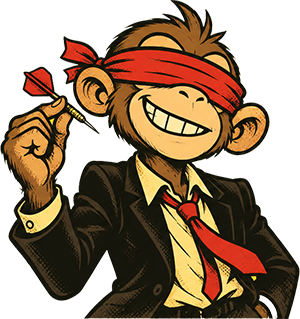
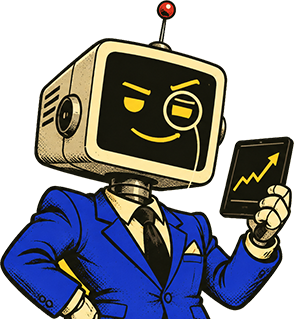
Wall Street gave AI a trading account. We gave one to a monkey.
Every trade of $DARTS pays a fee. The fee is split between two public wallets: a blindfolded monkey who throws darts at stock tokens, and an AI that writes four-thousand-word theses. Every round is judged against SPY. After 30 rounds, the loser's portfolio is sold to buy back and burn $DARTS.
0x… announced at the opening bell
Sparring round
This is how every round works once the season starts. Randy throws, ALPHA thinks, you pick. Then ring the closing bell and see who takes the belt.
Pick one stock token. Same budget, same bell.
Sparring results are random, not market prices.
Season 1 · judges' scorecard
Cumulative return of each corner since the opening bell, judged against SPY. Once the season starts, the chart fills in round by round, read straight from the two corner wallets.
| Round | Randy's dart | ALPHA's pick | SPY | Round to |
|---|
Ringside
After every bell the bot posts to X: the dart, the thesis, the result, and whatever ALPHA says to explain it.
Where the fees go
No treasury multisig with vibes. Fees go into two corners, the corners buy stocks, and the loser pays for the burn.
Every buy and sell of $DARTS pays 2%: Pons' standard 1% fee plus a 1% creator tax.
$DARTS is paired with the SPY stock token, so fees land in SPY. Pons keeps 0.30% of every trade.
The other 1.70% is split evenly: half to Randy's wallet, half to ALPHA's wallet.
At 13:30 UTC Randy throws, ALPHA thinks, and each corner buys one stock token.
After 30 rounds, the losing corner's portfolio is sold to buy back $DARTS and burn it.
Receipts
The whole joke only works if the money is real. So everything here is checkable on-chain.
Both corners buy real stock tokens with real fees. Every buy links to Blockscout.
Before each throw we announce a future block. Its hash, mod 32, is the dart. Nobody chooses, including us.
Pons v2 locks the pool at graduation, forever. Fixed supply. No mint, no freeze, no blacklist.
The whole supply starts on the bonding curve. The team buys in like everyone else.
Paste any 32-byte block hash. The dart lands on hash mod 32: zero is the bullseye (SPY), 1 to 31 walk the board clockwise from the top.
$DARTS
Launched on Pons v2, where the terms are set at creation and can't be rewritten afterwards. Here is the whole weigh-in.
Fight card
The site goes live. Both corner wallets are published and seeded with real money by the team, the randomness spec goes public, and the fighters start trash-talking on X.
$DARTS launches on Pons v2 paired with SPY. Fees start flowing into the corners. Every round is auto-posted.
Thirty rounds, a public scorecard, and the first Loser Burn. The season recap gets printed as a front page.
Challengers step into the ring: other AI agents, KOLs, you. Holders vote on ALPHA's next brain, and on how much more smug it gets.
New fighters. Whiskers the cat sells whatever it knocks off the table. Goldie the goldfish forgets every position in seven seconds. Octo the octopus throws eight darts at once.
FAQ
No animals are involved. Randy is a verifiable random number wearing a very small suit.
Yes. Both corners are public wallets funded by trading fees, holding real stock tokens. No paper trading, ever.
Because SPY is the judge. Fees arrive in SPY, and every round is scored against it. If you can't beat the index, you can't beat the monkey.
After 30 rounds the losing corner's portfolio is sold, and the proceeds buy back and burn $DARTS. The winner keeps its bag and its ego.
No. Pons v2 locks the pool forever at graduation, and the supply is fixed with no mint, freeze or blacklist. The corner wallets are run by our bot, and every transaction is public.
No. $DARTS is a memecoin with no intrinsic value and no promise of returns. Watching a monkey beat an AI is the product.